
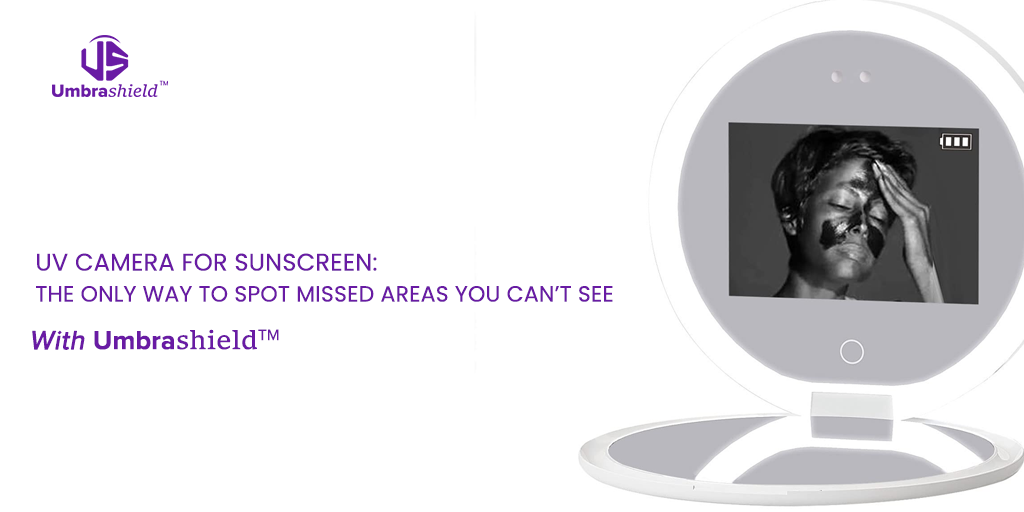
UV Camera for Sunscreen helps you see what normal light hides. It shows missed spots, uneven coverage, and how well your sunscreen actually blocks UV, making daily protection far more accurate.
If you have ever walked out in the sun thinking your sunscreen is on perfectly, only to find a patchy tan or a random sunburn later, you already know the truth. We miss spots far more often than we realise. The cheeks, the sides of the nose, the hairline, the jaw, all these little corners are easy to skip.
A UV camera is the only tool that lets you actually see what your sunscreen is doing on your skin. You cannot see UV absorption with normal eyes. You cannot judge coverage by feel. But the camera shows it in seconds.
Many dermatologists use UV imaging to study sunscreen behaviour because it reveals a layer the naked eye cannot. When you see your face under UV for the first time, it feels a bit shocking. Sunscreen suddenly looks dark, almost like a mask. Any area that looks lighter is where you missed a spot or did not apply enough. Once you see this, you never apply sunscreen the same way again.
Now let’s break down every real question people ask about UV cameras for sunscreen and explain it in a simple way anyone can follow.
How does a UV camera show whether my sunscreen is actually working
A UV camera reacts to how sunscreen absorbs ultraviolet light. UV filters in sunscreen soak up UV rays so your skin does not. When a UV camera looks at skin, areas covered with sunscreen appear dark because the product blocks the UV. Bare skin appears lighter because it reflects UV.
So if your sunscreen layer is strong, you will see a darker and even tone. If it is patchy, the bright areas will jump out instantly. The first time someone tries this, they usually spot tiny gaps that they never felt while applying the product.
Can a UV camera reveal the spots I missed while applying sunscreen
Yes, and it reveals them better than any mirror ever could. Missed areas look bright under UV. These are usually the places we ignore without realising. For example:
- Edges of the nostrils
- Front of the ears
- Eyelid corners
- Jaw corners
- Areas under facial hair
- Hairline
- Space between brows
Even if you think you applied sunscreen carefully, a UV photo proves how tiny gaps add up. Once you fix your technique using the camera, your daily sunscreen routine becomes much more reliable.
Is a UV camera reliable for checking sunscreen coverage at home
Yes, you do not need a clinic. A UV camera or a UV enabled device can show real sunscreen absorption at home because the science behind it is straightforward. As long as the device captures UV A light properly and you use consistent lighting, what you see is accurate.
People use UV cameras at home to:
- Train themselves to apply sunscreen evenly
- Check if they missed spots before going outdoors
- Show kids how sunscreen works
- Understand how long a product stays visible on their skin
The home results match what dermatologists observe in clinic settings, which is why UV cameras have become popular for personal skincare education.
Which UV camera is best for testing sunscreen effectiveness on the face
The best UV camera is one that clearly captures UV A absorption. Full UV imaging systems used in studios give the cleanest results, but portable devices have improved a lot.
When selecting one, look for:
- A camera that specifically captures UV A range
- A lens that does not block UV
- Stable lighting
- Ability to show contrast between covered and uncovered skin
For home use, compact UV cameras are usually enough. Some users like phone based attachments, but the results vary depending on the phone’s camera and how the attachment handles UV pass filters.
Dermatologists still prefer full UV rigs for detailed skin analysis, but for sunscreen, you mainly need clear contrast, not medical grade imaging.
Can a UV camera help compare how different sunscreens perform on my skin
Yes, and that is one of the most interesting things about UV photography. When you apply two sunscreens side by side, the camera shows differences instantly.
You may find:
- One product looks darker because it absorbs UV better
- Another leaves uneven patches
- Some feel heavy but actually show stronger UV absorption
- Lightweight gels sometimes appear lighter if the film is not thick enough
It teaches you that “texture preference” and “UV performance” are not always the same. People often discover that a product they loved for its feel was not giving the coverage they assumed.
This does not replace SPF testing done in labs, but it helps you personally understand which sunscreen forms a more even film on your own skin.
Does a UV camera show how long sunscreen protection lasts outdoors
It shows how long the visible UV absorbing layer remains on your skin. Over time, the dark mask slowly fades. Sweat, rubbing, and time all reduce the layer.
What you observe visually helps you understand why reapplication is important. For example, you may notice:
- The nose loses coverage the fastest
- Areas you touch often fade quickly
- Sunscreen on oily skin disappears faster
- Outdoor activity removes product faster than indoor work
The camera will not measure SPF hours accurately because SPF testing needs controlled lab exposure, but it gives a real world picture of how the layer breaks down.
“If you want daily sun protection without reapplying sunscreen again and again, you can also check the Umbrashield UV Face Shield collection. It helps block harsh UV outdoors and works well with sunscreen.”
Are phone based UV camera attachments accurate for sunscreen tests
Some are decent, others are inconsistent. Phone camera sensors are not designed for UV, so manufacturers rely on UV pass filters that let only UV A light enter while blocking other wavelengths. If the filter quality is good, the results look clear. If not, the image looks dull or washed out.
People usually notice these differences:
- Good attachments show a strong dark mask where sunscreen sits
- Cheaper ones show a gray filter that does not reveal details
- Some struggle indoors unless the lighting is bright
- Others work well only in natural sunlight
So yes, many phone attachments work, but check sample images or user reviews before you choose one.
What setup or lighting do I need to take proper UV camera sunscreen photos
Lighting makes a huge difference. UV cameras need consistent UV A light. You can use:
- Natural sunlight
- A UV A lamp
- A strong outdoor open shade area
Avoid fluorescent indoor lights because they rarely have strong UV A output.
For clear photos:
- Place your face in even lighting
- Avoid shadows
- Keep the camera stable
- Do not mix sunlight and indoor light
- Do not turn on bright white LEDs nearby
Sunlight usually gives the best contrast because it contains the right amount of UV A.
Where can I buy a UV camera for sunscreen testing with fast delivery
Most people buy them online because UV cameras are not commonly sold in local stores. Options usually include:
- E commerce platforms with fast shipping
- Specialty photography suppliers
- Brands that make portable UV devices for skin education
Delivery speed depends on stock, location, and whether the seller offers express shipping. Many portable UV cameras arrive within a few days if they ship locally.
Before buying, check:
- Sample UV photos
- Whether the camera captures UV A
- Return policy
- Warranty
This ensures you get a device that actually displays sunscreen contrast instead of a normal filter pretending to show UV.
How do I interpret the UV camera results to know if my sunscreen is applied correctly
It is easier than you think. Here is how the camera reveals your application quality:
1. Dark and even surface
This means the sunscreen is absorbing UV properly and you have applied a good layer.
2. Light or bright patches
These are missed spots or thin areas.
3. Streaks
Happens when sunscreen was spread unevenly or rubbed too quickly.
4. Patchy fade
This often appears after sweating, wiping your face, or wearing a mask.
5. No darkness at all
This usually means the sunscreen does not absorb UV enough for the camera to read. Some mineral sunscreens reflect UV instead of absorbing it, so the image may look different.
Once you learn how to read the patterns, applying sunscreen feels almost like painting a surface evenly. You start noticing small habits that improve protection. For example, many people start using extra dots around the nose, on the eyelids, or around the mouth once they see how often these areas show bright patches.
Final Thoughts
A UV camera is not a gimmick. It is a simple scientific tool that shows something your eyes cannot. It teaches you how to apply sunscreen properly, how different formulas behave, and how long the film stays on your skin. Anyone who steps outdoors often or has sensitive skin gains real value from seeing their sunscreen in UV.
It does not replace SPF lab testing, but it gives you real world awareness of your own habits. Once you see your face under UV, the missed spots become unforgettable. You start correcting them automatically, which means fewer random tans, fewer uneven burns, and better long term skin protection.