
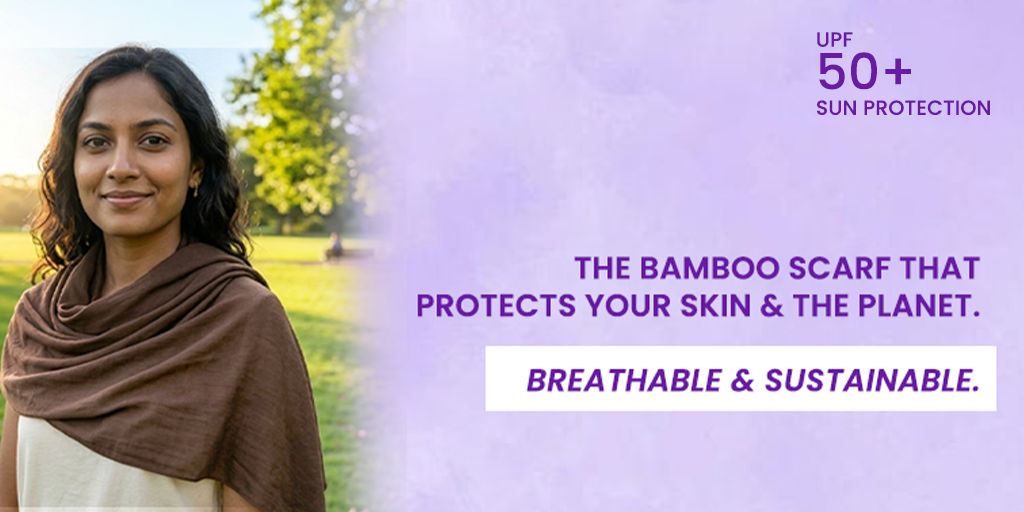
Reapplying sunscreen every two hours sounds simple — until you are in the middle of a school run, a work meeting, or a long drive. Real life does not pause for SPF. And that gap between your morning application and the next one? That is exactly when UV damage quietly adds up — on your neck, your jawline, your scalp, and everywhere sunscreen missed or wore off.
Umbrashield’s bamboo scarf is built for that gap. It sits on your skin all day, blocks 98% of UVA and UVB radiation with a UPF 50+ certified fabric, and needs zero reapplication. No chemicals. No residue. No timing. Just a lightweight, breathable scarf that protects you from the moment you put it on — and keeps protecting until you take it off.
What makes it different from any other scarf is simple: cotton gives you shade, bamboo gives you protection. A standard cotton scarf blocks almost no UV — it typically rates UPF 5 to 7, meaning up to 20% of UV radiation still passes through the fabric and reaches your skin. The Umbrashield’s bamboo scarf is engineered to UPF 50+, blocking 98% of both UVA and UVB radiation — the same standard dermatologists recommend for post-procedure sun care.
Cotton is comfortable, yes — but for sun protection, it simply does not perform. Bamboo fabric also stays 3°C cooler than cotton under direct sun, wicks moisture away faster, and sits against sensitive or recovering skin without any friction or irritation. And beyond your skin — bamboo is one of the most sustainable fabrics on the planet.
It grows on rainwater alone, needs zero pesticides, uses just a fraction of the water cotton requires, and is fully biodegradable with zero microplastic waste. In this guide, you will find everything you need to know: what a bamboo scarf actually is and how it is made, why it outperforms cotton for sun protection, the science behind UPF 50+ and why it matters for your skin, how it compares directly to a regular scarf, which skin types and lifestyles benefit most, and why the bamboo scarf is fast becoming the most intelligent sun protection and sustainable fashion choice for women across the globe.
What Is a Bamboo Scarf — And Why Is Everyone Talking About It?
The bamboo scarf is a wearable accessory composed of bamboo-derived textile fibers which are most often the bamboo viscose or bamboo Lyocell. Bamboo is processed into a soft, breathable fiber that is more soft than cotton and lighter than linen and more gentle on the skin in comparison to synthetic mixes. It is the result of an outfit that does more than simply look nice, it actually performs.
The current bamboo fabric industry began in the mid 2000s when research into textiles that was initiated at Beijing University around 2001 -opened up bamboo’s potential as a wearable fabric. In the middle of 2010, bamboo clothing had grown by nearly 5,000% as a business segment. Nowadays, it’s woven in everything from sportswear bedding to high-end sun-protection items used across six continents.
From Bamboo Plant to Bamboo Fabric — How It’s Made
Bamboo stalks that are raw are harvested to make an emulsifying solution, then spun into ultra-fine fabric. The fibres are innately smooth, which is the reason bamboo fabric doesn’t cause the micro-friction that can irritate skin that is sensitive. The fiber structure also produces natural gaps that let moisture and air to flow freely, which is the main basis for bamboo’s breathability.
Types of Bamboo Scarves: Head Scarf, Infinity Scarf, Silk Scarf & More
- Bamboo head scarf: complete neck and scalp coverage to protect against UV rays in the outdoor environment.
- Bamboo infinity scarf: in a looped, layered look to make a versatile piece for your everyday wear
- Bamboo silk scarf: extremely fine, high-end drape suitable ideal for special occasions and travel
- Bamboo jersey scarf: soft and stretchy, it is ideal for active outdoor pursuits
- Bamboo cooling scarf: designed for hot climates and extended exposure to sun.
- Bamboo chemo scarf: mild, hypoallergenic choice for skin with sensitive medical conditions
Is a Bamboo Scarf Good for Sun Protection? Here’s the Science
This is the one that differentiates the bamboo scarf from all other available scarves. The answer is simple: it is based on the design of the fabric. Bamboo is a common material that offers more durability against ultraviolet than cotton; however, a UPF 50+ certified bamboo scarf such as the one offered by Umbrashield, falls into a totally distinct category.
UPF – Ultraviolet Protection Factor is the equivalent in textiles of SPF. A UPF 50+ bamboo scarf block 98 percent of UVA as well as UVB radiation. explore our UV Sun Scarf — engineered to the same gold standard. It is the Skin Cancer Foundation classifies this as the highest quality sun protection clothing. A normal cotton scarf, for example, generally has UPF 5-7. This means that as much as 20% of UV radiation is absorbed through the fabric before hitting the skin.
UPF 50+ vs Regular Scarf — Why Fabric Rating Matters for Your Skin
The majority of people think that all scarves provide sun protection. It doesn’t. A loosely-woven synthetic or cotton scarf permits UV radiation to penetrate easily and provide shade and not security. The uv protection bamboo scarf made by Umbrashield is designed at the fiber layer to block ultraviolet and not only shade it. It’s the same concept dermatologists use when they recommend sun-protective clothing for chemical peels, laser treatments or melanoma healing.
Bamboo Cooling Scarf — How It Keeps You 3°C Cooler in Peak UV Hours
The micro-gap design that makes up bamboo fabric effectively circulates air around the skin. The tests on bamboo’s thermal properties show that bamboo keeps the skin 3°C cooler than cotton when exposed to direct sunlight. In cities with high UV levels that span from Sydney up to Dubai to Mumbai the temperature differential is the line of sun-protection that is comfortable and uncomfortably hot stress. A bamboo cooling scarf is more than just a protection. It’s a comfortable, well-engineered.
Chemical-Free UV Defence — The Case for Wearable Sun Protection
Chemical sunscreens, even the most effective ones, get ruined under the ultraviolet light that they were designed to block. They need to be applied with precision each two hours. They are in contact with water, sweat, and makeup. The sun protection bamboo scarf eliminates the need for this. It offers consistent, chemical-free UV protection from the time you apply it to the time when you take it off. No timing, no reapplication, no residue. All you need is protection- embedded in every fibre.
Bamboo Fabric for Skin — Why Dermatologists Are Recommending It
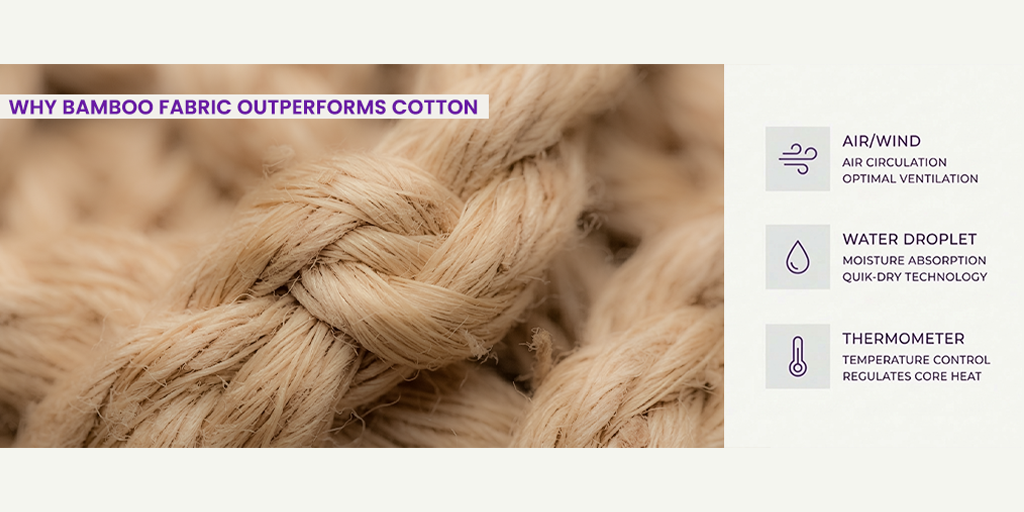
Beyond UV protection, the bamboo scarves has become a dermatologist-recommended option for women with a wide range of skin conditions. The reason is straight forward bamboo fabric are soft, round, and free of micro-barbs that create friction irritation in synthetic and cotton fabrics. For skin that is irritable or damaged, or recovering — this can be a problem tremendously.
Breathable Bamboo Scarf for Sensitive Skin and Eczema
The breathable bamboo scarf ensures a constant flow of air against the skin, lessening the accumulation of heat that causes eczema flares as well as Rosacea. Its antimicrobial nature ensures that there are fewer bacteria in it, and is particularly crucial for skin that gets irritated when exposed to irritants. For women who wear a bamboo scarf for sensitive skin requirements, this is not an option to be considered a luxurious item. It’s a requirement of the medical profession.
Hypoallergenic Bamboo Neck Wrap — Safe for Post-Procedure Recovery
Following laser resurfacing, microneedling or chemical peels, the skin goes into a very vulnerable condition. Any kind of friction, exposure to chemicals or UV penetration can ruin weeks of expensive treatments. The hypoallergenic bamboo neck wrap from Umbrashield provides the gentle, zero-friction coverage dermatologists recommend during recovery windows. Explore the full range at our Sun Protection Scarf collection.
during recovery times without the need to reapply the requirements of SPF creams for recovering skin. This bamboo chemo scarf has the same purpose for patients who are undergoing treatment for skin conditions that are damaged by medical conditions.
Moisture-Wicking Bamboo Clothing — Staying Dry All Day
Bamboo fibre is able to absorb 40% more moisture than cotton and draws away from the skin in a matter of seconds. The ability to wick moisture keeps the skin hydrated during prolonged outdoor activities — crucial to avoid the buildup of bacteria and irritation to the skin that can occur when sweat is sucked up against your jaw and neck in the warm temperatures. Bamboo clothing worn close to your surface of the skin are, in that regard an effective skincare product.
Bamboo Scarf vs Regular Scarf for Sun Protection — What’s the Real Difference?
The issue isn’t which one looks more attractive. It’s which one actually shields your skin? Here’s the reality side-by-side:
| Parameter | Bamboo Scarf (UPF 50+) | Regular Cotton/Synthetic Scarf |
| UV Protection | UPF 50+ — blocks 98% UVA & UVB | UPF 5–7 — up to 20% UV passes through |
| Breathability | 50% more breathable than cotton | Traps heat, poor air circulation |
| Moisture Wicking | Pulls moisture away instantly | Holds sweat against skin |
| Skin Compatibility | Hypoallergenic, zero irritation | May cause friction and rashes |
| Antimicrobial | Natural — no odour buildup | None — bacteria breeds in fabric |
| Temperature Feel | 3°C cooler on skin | Can feel heavy and warm |
| Weight | Ultra-lightweight, travel-ready | Often heavy or stiff |
| Chemical-Free | 100% — no SPF chemicals needed | No UV protection at all |
UPF information: Skin Cancer Foundation | Textile data: Journal of Photochemistry and Photobiology Data on thermal: Textile Research Journal
The conclusion is obvious: A regular scarf will give you shade. Bamboo is a great choice. bamboo scarf men with UPF 50+ offers clinically rated UV protection. It’s the same method dermatologists use to post-procedure care of the sun. If you are serious about your the health of their skin, there’s no better choice than this.
Why the Eco-Friendly Bamboo Scarf Is a Smarter Choice for the Planet
The sustainable nature that comes from bamboo fabric isn’t a mere commercial claim. It is verified, quantifiable and substantial. Although sun protection is the main motive to purchase Umbrashield’s bamboo scarf, the environmental benefits are an actual benefit that is increasingly important to mindful buyers.
Organic Bamboo Scarf — Grown Without Pesticides or Irrigation
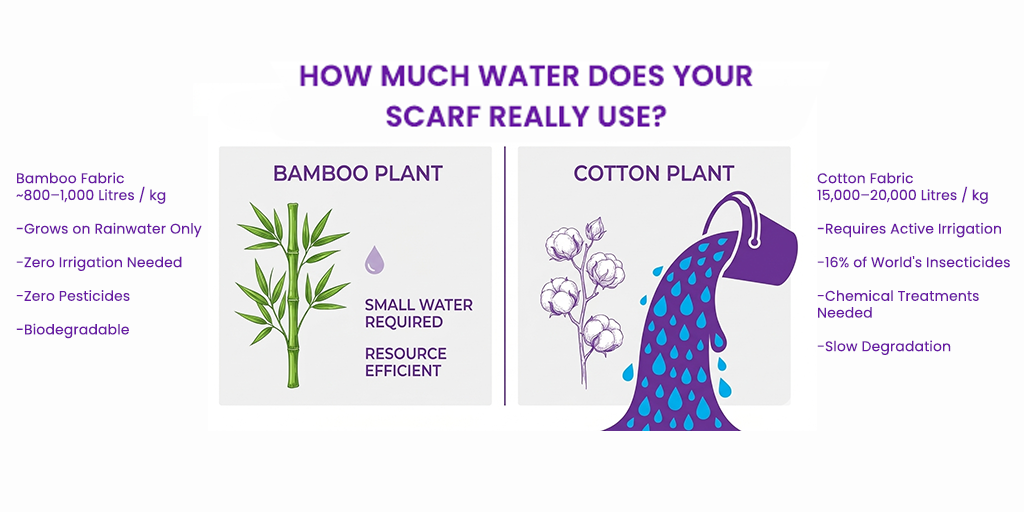
Conventional cotton uses 16% of the world’s insecticides on just 2.5% of global farmland (Textile Exchange). Bamboo needs none. It grows on rainfall alone, regenerates from its roots without replanting, and requires zero pesticide application. The organic bamboo scarf is, from the ground up, a cleaner product — for the soil, the water table, and the farmer.
Biodegradable Fashion Accessories — Zero Microplastic Promise
Synthetic fabrics release microplastics each time they wash. These particles can be found in deep ocean sediments and human blood. Bamboo fabric is completely biodegradable; it breaks down naturally, without leaving behind a microplastic footprint. Making the choice of biodegradable fashion accessories such as Bamboo scarfs are among the simplest, most impactful choices for consumers.
Sustainable Bamboo Scarf — Save Water, Save Soil, Save Future
Cotton requires up to 20,000 litres of water per kg of fabric (WWF, 2021). Bamboo uses approximately 800–1,000 litres, growing on natural rainfall with no irrigation. That is 1/200th the water footprint. The sustainable bamboo scarf is not just good for your skin. It is good for every community living downstream of a cotton farm.
Who Needs a Bamboo Scarf? Real People, Real Reasons
Bamboo Scarf for Women — Everyday Elegance with UV Defence
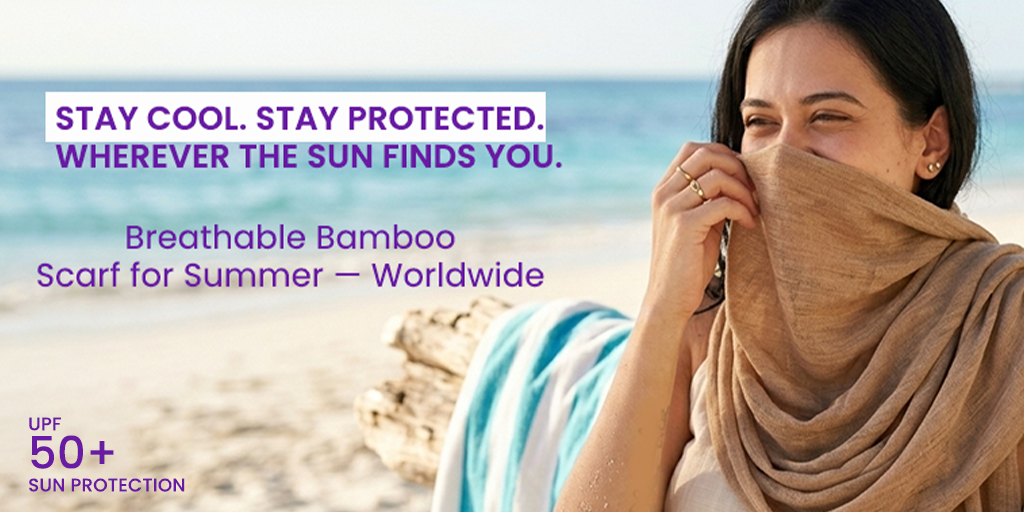
This bamboo scarf for women is made to be worn by women who do not want to compromise on looking great while protecting the skin. Browse the complete Umbrashield’s UV Protection Garments collection for full-body wearable sun protection. Wrapped around the neck for an early morning commute, layered as a head cover during a day at the beach or rolled up as a shawl for an evening outdoor meal It provides constant UPF 50+ sun protection with a fabric that moves and feels unlike anything other.
Bamboo Scarf for Summer Travel — Lightweight, Packable, Protective
The softest bamboo scarf for travel is one that can be tucked into the pocket of a jacket, is able to survive travel and is similarly well during the humid climate of Bali or the hot dry climate of Marrakech and the sun-saturated beaches in the Mediterranean. Bamboo scarf lightweight women searches are on the rise precisely because travellers have realised that wearing a single bamboo scarf for summer is able to replace reapplication of sunscreen 100% to provide neck, jaw and scalp protection.
Bamboo Scarf for Sensitive Skin — When Your Skin Needs Extra Care
It doesn’t matter if you’re managing the effects of eczema or recovering from a surgical procedure for the skin, going through chemotherapy, or just struggling with skin which reacts to everything, you’ll experience bamboo scarf for sensitive skin is the treatment option that your dermatologist will approve. Zero chemical treatment. Zero friction. Continuous UV protection. It is soft enough to be worn directly against the skin post-treatment without causing further inflammation.
Why Bamboo Scarves Are the Fastest-Growing Wearable Sun Protection Category
Google Trends data shows two consistent annual peaks for bamboo scarf searches: May through August — when UV protection intent dominates — and November through December, driven by sustainable gifting and winter fashion. Bamboo scarf for women and eco-friendly bamboo scarf are among the fastest-growing sub-queries in the sustainable fashion category, with bamboo apparel showing 15% year-over-year search growth globally.
The UV protection bamboo scarf sits at the intersection of two of the fastest-growing global consumer categories: sustainable fashion and dermatological sun protection. This is not a coincidence. It is where the market is going — and where Umbrashield already is.
Explore More Sun Protection Guides from Umbrashield
The bamboo scarf is one part of a complete sun protection strategy. Explore the full Umbrashield guide library:
- The Ultimate Guide to Sun Protection Scarves: UPF 50+ Full-Body Defence
- Post-Procedure Recovery: Why a UV Protection Scarf is the Dermatologist’s Choice
- Stopping Driver’s Side Aging: Why a Face Scarf Protects Your Most Exposed Skin
- Stopping the Invisible Crisis: UV Protection for Hair Health & Scalp Aging
Bamboo Scarf — Frequently Asked Questions
Q: What is a bamboo scarf?
A: A bamboo scarf is a fashion accessory composed of bamboo-derived fibres, usually bamboo viscose or lyocell. It is more soft than cotton and naturally wicks moisture and is hypoallergenic. It is also biodegradable. When it is certified to UPF 50+ it blocks 98 percent of UV radiation, thus making it an attractive piece of clothing and an effective skin-protection tool.
Q: Is a bamboo scarf good for summer?
A: Yes -and especially so. The bamboo fabric has 50 percent less breathable and abrasive than cotton, and it wicks sweat 40% more quickly and helps keep skin 3 degrees cooler. It is ideal for use in summer, whether you are commuting or traveling, or just going out in the sun. A breathable bamboo scarf is among the most practical sun-protection alternatives to be found.
Q: Is bamboo healthier than cotton for skin?
A: For sensitive, reactive or post-procedure skin – yes. Bamboo fibers are smooth and round, which causes no friction-related irritation. The fabric has a natural antimicrobial component that stops the growth of bacteria. Dermatologists throughout North America, Europe, and Asia suggest bamboo clothes for those with weak or irritable skin barrier.
Q: Does bamboo fabric release microplastics
A: No. Bamboo is a natural plant-based fiber and doesn’t shed microplastics in the course of washing, contrary to synthetic fibers like polyester which discharge millions of tiny particles each cycle. The choice of a bamboo scarf instead of synthetic ones is an immediate reduction in microplastic footprint.
Q: What are the downsides of bamboo fabric
A: The principal reason is that the production of bamboo viscose requires a chemical procedure. But, certified companies utilize closed-loop systems for treating and recover the chemicals, minimizing the environmental impact. When buying, look for bamboo clothing made with OEKO-TEX certification to ensure the item is safe from the source to the store shelves.
Q: Is a bamboo scarf better than a cotton scarf for sensitive skin?
A: Yes it is in almost all instances. Bamboo fibre isn’t contaminated by micro-barbs, does not require chemical treatment with pesticides, and is an antimicrobial natural property; these are all reasons that make it the ideal fabric for eczema-prone, sensitive, as well as post-treatment, skin. An organic bamboo scarf is the dermatologist-recommended option for anyone with reactive skin.
Q: Can you wash a bamboo scarf
A: Yes. Machine wash with warm or cold water using gentle cycle. Dry in the air to maintain UPF rating and softness. Avoid using hot water or tumble drying with high heat. If properly maintained, bamboo scarves will keep its properties of protection and softness throughout hundreds of washing cycles.
Q: Does bamboo clothing get stinky?
A: No the bamboo fabric is anti-odour. Bamboo plants contain a natural antimicrobial which inhibits the growth of bacteria responsible for the odour of fabric. Bamboo scarves are perfect for outdoor wear that lasts a long time as well as for travel and regular washing.
Q: What is the truth about bamboo fabric
A: Bamboo fabric is among the most environmentally friendly and skin-friendly fabric options. It is made from a tiny fraction of cotton’s water, uses the use of no chemicals, and is also biodegradable and hypoallergenic, and has the potential to earn UPF 50+ accreditation. The truth is that bamboo viscose is a chemical process — which responsible producers tackle through closed-loop manufacturing that is certified.
Q: Does a bamboo scarf provide UV protection
A: Yes as long as it is made to UPF 50+. Research published in the Journal of Photochemistry and Photobiology confirms that bamboo fibres have powerful UV blockers. UPF 50+ bamboo scarves block 99 percent from UVA as well as UVB radiation – as opposed to UPF 7 in cotton. The UV protection bamboo scarf is a legitimate, dermatologist-approved sun protection tool.
Q: Is bamboo fabric eco-friendly
A: Yes. Bamboo grows on rainwater and does not require fertilisers or pesticides, grows without replanting. It produces 35 percent more oxygen than comparable trees and has a carbon footprint of 60 to 70% less than cotton that is conventional (Textile Exchange 2024). Bamboo is sustainable and an eco-friendly option that is verified and acknowledged by certification bodies across the EU, UK, USA and Australia.
Q: Where can I buy a bamboo scarf?
1. Umbrashield provides a high-end UPF 50+ bamboo scarf designed to protect against sun damage, and is available on umbrashields.com. The scarf is specifically designed for women living in extreme UV conditions who require the protection of dermatology and sustainable style. The Umbrashield’s bamboo scarf is a great choice for both. Sun protection like never before.
The Bamboo Scarf Is Not a Trend — It’s the Future of Smart Sun Protection
The sun protection system is now catching up with what we do. It is not necessary to apply sun protection every 2 hours. We don’t remember to cover our jawline prior to an extended journey. We don’t consider the UV rays that pass through our windows until the damage is done.
Bamboo scarf seals all these gaps – simply elegantly, beautifully, and forever. It offers UPF 50+ protection which never deteriorates. It’s soft enough to use on the most sensitive skin. It is constructed from eco-friendly bamboo fabric that the earth is not require to pay the price of. It works in every weather, on every skin type, and in every lifestyle.
This isn’t an unfashionable trend. The direction in which in which skincare and sustainable fashion are taking together. Umbrashield is leading the way.